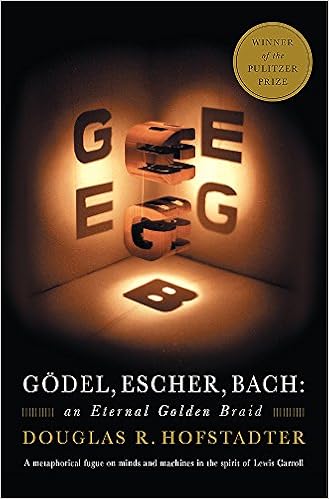
Gӧdel, Escher, Bach: an Eternal Golden Braid by Douglas R. Hofstadter
1. Where is the book on the narrative continuum?
A mix (contains highly narrative moments with periods of fact-based prose)
2. What is the subject of this book?
Hypothesizing the nature and origin of consciousness by examining "strange loops" (repetitions that appear to be self-generating) in the artwork of M. C. Escher, the music of J. S. Bach, and the mathematics of Kurt Gӧdel.
3. What type of book is it?
A long-form, interactive lesson taught by the author, interspersed with regular narrative sections in the form of fables.
4. Articulate appeal:
- What is the pacing of the book?
A slow burn, but the pacing relates to the reader's familiarity with the concepts being discussed, and greater familiarity will facilitate faster reading and a quicker pace.
- Describe the characters of the book.
The book has few characters, and when they exist they usually are simply a stand-in for an idea. In the many fables that pepper the book, readers will grow accustomed to the characters of Achilles, Tortoise, and Crab; in discussions about mathematical, musical, and artistic concepts, Gӧdel, Bach, and Escher are characters, but little is discussed about their lives or personalities - the book is all about their ideas. - How does the story feel?
Like wandering in darkness until small lights start to flicker on as you begin to understand the author's ideas. Challenging, but thought-provoking and perspective-enlarging. - What is the intent of the author?
To teach the reader new concepts and ways of thinking about the world, and kindling in the reader a sense of experimentation and discovery. - Does the language matter?
Not much - the words are a vehicle to ideas, but the reader will not sink back into exquisite sentences and phrasing. - Is the setting important and well-described?
No, there is no setting, and setting is largely irrelevant to the book. - Are there details and, if so, what?
There are heaps upon heaps of details, mostly logical and mathematical, and the reader will need to be interested in learning many, many small details in order to understand larger concepts. - Are there sufficient charts and other graphic materials? Are they useful and clear?
There are many illustrations and graphical representations of the concepts discussed in the book, and for the most part, they are helpful additions to the text. - Does the book stress moments of learning, understanding, or experience?
All three, and these moments are the primary goal of the book. Whether the reader experiences these moments of understanding and learning will make or break how they experience the book as a whole.
- Learning and discovery
- Interest in logic and mathematics
- Detail-oriented