Books and reading have changed surprisingly little for me since I was young. I read avidly as soon as I was able to, and have continued doing so. My reading habits have gone through phases, of course, as I assume most people's have. I had a literary classics kick and a period of time where I desperately tried to enjoy reading Thomas Pynchon, but now I tend toward reading science fiction and poetry. College helped open my eyes to the literary forms of poetry and graphic novels, and my interest in both of those has continued since college. In terms of format, however, the biggest change from my younger self's reading habits to my own is how I access reading materials. My local public library offers Hoopla and Overdrive access to library card holders, and I have used these quite a lot to access audiobooks. When I was younger, I listened to audiobooks occasionally, but I only ever reread books as audiobooks (and mostly just the Harry Potter series, which came in doorstopper sized cassette tape collections); now I enjoy experiencing books for the first time in their audio format. I haven't found myself embracing the ebook format, and doubt I ever will, but I have nothing against it and think it's a valuable alternative to printed book format.
As for the future of books, reading, and publishing, I don't anticipate any seismic shifts in the way we read and consume printed media. The internet and ebooks have been around for long enough now that they have become just another part of the reading landscape, and I think if the majority of the public was going to stop reading physical books altogether because of the allure of more attention-grabbing, passive material it would have done so already. I'm sure that reading is generally less popular than it was 30 years ago, but physical book publishing is still going strong, and I don't anticipate it going anywhere soon. The main concern I have about the future of the publishing industry is its environmental impact. As we face increasingly devastating human-made climate change, I think it is important that we reexamine all of our consumption habits, and that includes how we produce and purchase reading material. I think e-reader technology will advance greatly in the next 20 years and hopefully more people (including myself) will learn to love it and recognize that embracing it is a good step toward being an ecologically responsible consumer. My biggest concern about the state of reading 20 years in the future is that our increasing reliance on screens will continue to lower our collective attention spans to the point where reading books will be increasingly difficult in a world where most of our media is passive entertainment. However, I think there will always be a place in our culture for people who enjoy the challenge of reading and the satisfaction of delving deeply into the written words of others.
Saturday, April 27, 2019

Tuesday, April 16, 2019
Week 15 Prompt
Three Ideas for Marketing Readers' Advisory
1. Shelf Talkers - A strategy recommended by Carrol (n.d.) in which books are placed with their covers facing out for passing readers to see, and accompany them with brief reviews, blurbs, or recommendations from library staff. I have seen this strategy used to great effect in bookstores, and I think the concept is even more appealing in a context like a library in which you don't have to be wary about being advertised to so you will buy something! Saricks (2005) points out that the majority of readers looking for a good book in the library are browsers, roaming the shelves for something that looks appealing, and Shelf Talkers are designed to engage with them.
2. Online Readers' Advisory Service - Just as many libraries have "Ask a Librarian" chat applications embedded in their web pages, Burke and Strothmann (2015) recommend that having a chat box marked "Looking for a Good Book?" or something similar can engage with readers who might never set foot in the library or who might be anxious about having a face-to-face conversation with a readers' advisory librarian. Librarians doing readers' advisory work can feel a little more at ease as they take their time trying to find the best possible recommendations for the patron rather than feeling rushed by the need to produce a fast result.
3. Themed Social Media Posts - At the library where I work, we create displays of books that fit certain themes, and then I create daily social media posts that give either a sample sentence, a brief blurb, or a short review of one of the books in the display posted with a picture of the book's cover. This has worked extremely well, both as a tool for making patrons aware of the library's books for, say, Black History Month, as well as for making me more aware of the library's collection. As I spend time with the books I post about, I learn more about the range of materials we have in our various collections and I feel more confident about recommending books to patrons in the future.
Works Cited
Burke, S. K., & Strothmann, M. (2015). Adult Readers' Advisory Services through Public Library Websites. Reference & User Services Quarterly, 55(2), 132-143.
Carrol, Bill. (n.d.) Don’t Talk to Me: Passive Readers’ Advisory. Retrieved from https://www.statelibraryofiowa.org/ld/c-d/continuing-ed/iloc/copy_of_iloc-2016/handouts/dont-talk-to-me/donttalktome.pdf
Saricks, J. (2005) Promoting and marketing readers’ advisory collections and services. In Readers’ Advisory Service in the Public Library. Chicago: ALA. 136-160.
1. Shelf Talkers - A strategy recommended by Carrol (n.d.) in which books are placed with their covers facing out for passing readers to see, and accompany them with brief reviews, blurbs, or recommendations from library staff. I have seen this strategy used to great effect in bookstores, and I think the concept is even more appealing in a context like a library in which you don't have to be wary about being advertised to so you will buy something! Saricks (2005) points out that the majority of readers looking for a good book in the library are browsers, roaming the shelves for something that looks appealing, and Shelf Talkers are designed to engage with them.
2. Online Readers' Advisory Service - Just as many libraries have "Ask a Librarian" chat applications embedded in their web pages, Burke and Strothmann (2015) recommend that having a chat box marked "Looking for a Good Book?" or something similar can engage with readers who might never set foot in the library or who might be anxious about having a face-to-face conversation with a readers' advisory librarian. Librarians doing readers' advisory work can feel a little more at ease as they take their time trying to find the best possible recommendations for the patron rather than feeling rushed by the need to produce a fast result.
3. Themed Social Media Posts - At the library where I work, we create displays of books that fit certain themes, and then I create daily social media posts that give either a sample sentence, a brief blurb, or a short review of one of the books in the display posted with a picture of the book's cover. This has worked extremely well, both as a tool for making patrons aware of the library's books for, say, Black History Month, as well as for making me more aware of the library's collection. As I spend time with the books I post about, I learn more about the range of materials we have in our various collections and I feel more confident about recommending books to patrons in the future.
Works Cited
Burke, S. K., & Strothmann, M. (2015). Adult Readers' Advisory Services through Public Library Websites. Reference & User Services Quarterly, 55(2), 132-143.
Carrol, Bill. (n.d.) Don’t Talk to Me: Passive Readers’ Advisory. Retrieved from https://www.statelibraryofiowa.org/ld/c-d/continuing-ed/iloc/copy_of_iloc-2016/handouts/dont-talk-to-me/donttalktome.pdf
Saricks, J. (2005) Promoting and marketing readers’ advisory collections and services. In Readers’ Advisory Service in the Public Library. Chicago: ALA. 136-160.
Saturday, April 13, 2019
Week 14 Prompt
I would advocate for shelving Urban Fiction
separately from general fiction, but leaving LGBTQ fiction intershelved with
other fiction.
Reason 1: Urban
Fiction is a genre, while LGBTQ Fiction refers to the identity of the author
writing it. Of course, LGBTQ authors will tend to explore issues related to
their own experience in their writing, but these aspects of identity exist
independent from genre. Urban Fiction should be separated from General Fiction
for the same reason that mysteries should; readers tend to read and enjoy books
from specific genres, and shelving books by general genre categories makes them
easier to find and browse.
Reason 2: It is
impractical to try to separate the shelving location for books based on the
identity of their author or the presence of LGBTQ-related stories. Where should
you draw the line about what qualifies a book to be “LGBTQ Fiction”? Is it the
presence of one queer character? Is it whether the author has publicly come out
as queer? Does it include homoerotic undertones in literary classics? Whatever
criteria is used will be too inclusive for some readers and too exclusive for
others. Shelving by genre is not always a straightforward process either, but
it is much easier than trying to shelve based on identity because you can make
certain assumptions about the readers looking for books in the genre that you
can’t make otherwise. With Urban Fiction, there are general settings, story
types, character archetypes, and physical indicators (like cover art and publisher)
that can be used to distinguish the books.
Reason 3: Intershelving LGBTQ Fiction normalizes LGBTQ experiences. By cordoning off LGBTQ stories and media, we “other” it and label it as deviant in some way from the larger collection of “normal” fiction. If we intend to work toward a more just society in which people are not stigmatized for seeking out certain types of information or simply being a certain way, we must work to normalize inclusion of experiences different from the majority. I still think, however, that it would be helpful to have a way to direct readers who are specifically interested in books relating to gender, sexuality, and identity to books that would interest them, so I would encourage the library to begin adding a subject heading like “Gender, Sexuality, and Identity” to the OPAC records for any books whose content addresses those issues in one form or another. This will also aid readers’ advisory librarians in their work as they look for titles appropriate to readers questioning their gender or challenging social structures.
African American Annotations: Homegoing by Yaa Gyasi
.jpg/220px-Homegoing_(2016_cover).jpg)
Yaa Gyasi
Genre: Historical fiction, Family chronicle, African American
Publication date: 2016
Number of pages: 320
Geographical setting: Ghana, Alabama, Harlem
Time Period: 1760 - present
Plot Summary: In mid-18th century Ghana, British colonization has turned the world into a dangerous place for Effia and Esi, two Ghanaian half-siblings living in a village in close proximity to a British outpost. Effia marries a British soldier while Esi is captured and sold into slavery, and their respective lives, as well as the lives of their descendants, are recounted in this inter-generational chronicle. Each chapter provides a snapshot of an important time in the life of a different character in the family tree as the reader explores the lasting repercussions of racism, colonialism, and slavery.
Subject Headings: Slavery, Colonialism, Intergenerational, Ghana
Appeal:
- Pacing: moderate, steady
- Tone: tragic, haunting
- Writing Style: broad, sweeping, descriptive
Read-a-likes:
- Kintu by Jennifer Nansubuga Makumbi - an intergenerational story of a Kenyan family that spans hundreds of years of history, from a tragic accident in 1750 that brings a curse upon the family all the way through the early 2000s.
- There There by Tommy Orange - a novel following the lives and stories of twelve different people making their way to the Big Oakland Powwow and focusing on the struggles of Native Americans who have had their lands forcibly stolen from them.
- The Hundred Wells of Salaga by Ayesha Harruna Attah - a story set in pre-colonial Ghana following the wildly different lives of two women. This novel grapples with the politics and society of the time period as well as abuse and romance.
Related authors:
- Jennifer Nansubuga Makumbi
- Chimamanda Ngozi Adichie
- Imbolo Mbue
LGBTQ Annotation: Ammonite by Nicola Griffith

Nicola Griffith
Genre: Science fiction, LGBTQ, Adventure
Publication date: 2002
Number of pages: 360
Geographical setting: A planet known as "Jeep"
Time period: An unspecified time in the distant future
Plot summary: Humanity has attempted to colonize a distant planet called Jeep, but encountered a virus that wiped out a large percentage of the population and killed all men who set foot on the planet. The surviving members of the colony have dispersed across the planet except for a few that stay behind to maintain a military outpost. Marghe, a linguistic anthropologist, volunteers to travel to Jeep and study its inhabitants, but quickly leaves the protection of the outpost to join the planet's native inhabitants who have developed a mysterious symbiosis with the world's virus. This is a story of love, exploration, and hardship as Marghe travels the planet and faces a transformation that leaves her changed forever.
Subject headings: Sociology, Viruses, Gender roles, Extraterrestrial anthropology
Appeal:
- Pacing: Leisurely with bursts of speed
- Tone: Mysterious, though-provoking, adventurous
- Writing Style: Poetic, descriptive, compelling
Read-a-likes:
- The Left Hand of Darkness by Ursula K. LeGuin - this novel explores similar issues to Ammonite, exploring gender on a hostile, icy planet. LeGuin's novel is more interested in social and political situations that arise as a result of gender fluidity and an alien planet, and less focused on adventure than Ammonite is.
- China Mountain Zhang by Maureen F. McHugh - a story exploring a futuristic American society in which China has become the dominant world power. This novel focuses on characterization against a science fiction setting, and features queer relationships.
- Daughters of a Coral Dawn by Katherine V. Forrest - the story of a group of women who escape an oppressive patriarchal society to begin a new life in a matriarchal society of their own design on a distant planet.
Related authors:
- Ursula K. Le Guin
- Elizabeth Bear
- Mary Doria Russell
Sunday, April 7, 2019
Week 13 Prompt
As readers’ advisory librarians, we should
definitely work to ensure that we can help adult readers in search of young
adult and graphic novels. We should not shame readers for reading young adult
novels, because although they are marketed to a younger audience, they are not
of intrinsically worse quality than other books. There are certain prevalent
themes in young adult novels such as not fitting in and coming of age, and I
would describe these themes as being universal, and not just limited to a
certain age range. Young adult novels range widely in writing quality just as
all books do, and we should include young adult fiction reviewing sites and
publications in the resources we use for regular readers’ advisory work. We
should also try to expand our reading into the young adult genre (if we haven’t
already) so as to get a better sense of the landscape of contemporary young
adult writing. As Booth (2005) points out, teenage readers just want good
stories like the rest of us, and do not want to be moralized to.
Graphic novels are a whole medium containing a
wide variety of genres, so it would be ignorant to dismiss them as “childish”
or unworthy of attention for readers’ advisory. There are graphic novels
targeted at young adults, children, and adults, and I think it’s helpful for us
to read widely in these different genres to get a sense of unique appeal
factors. For example, in graphic novels the art style can be just as big an
appeal factor as the story itself, and patrons may have preferences: one person
might like graphic novels with a strictly realistic art style and another might
enjoy more figurative, unrealistic drawing. If we don’t regularly read graphic
novels as part of our readers’ advisory work, we won’t be able to identify
these appeal factors and properly recommend good graphic novels to our patrons.
Works Cited
Booth, H. (2005). RA for YA: Tailoring the
Readers Advisory Interview to the Needs of Young Adult Patrons. Public
Libraries, 44(1), 33-36.
Thursday, March 28, 2019
Week 12 Prompt Response
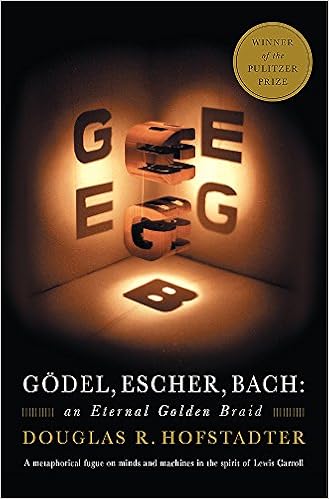
Gӧdel, Escher, Bach: an Eternal Golden Braid by Douglas R. Hofstadter
1. Where is the book on the narrative continuum?
A mix (contains highly narrative moments with periods of fact-based prose)
2. What is the subject of this book?
Hypothesizing the nature and origin of consciousness by examining "strange loops" (repetitions that appear to be self-generating) in the artwork of M. C. Escher, the music of J. S. Bach, and the mathematics of Kurt Gӧdel.
3. What type of book is it?
A long-form, interactive lesson taught by the author, interspersed with regular narrative sections in the form of fables.
4. Articulate appeal:
- What is the pacing of the book?
A slow burn, but the pacing relates to the reader's familiarity with the concepts being discussed, and greater familiarity will facilitate faster reading and a quicker pace.
- Describe the characters of the book.
The book has few characters, and when they exist they usually are simply a stand-in for an idea. In the many fables that pepper the book, readers will grow accustomed to the characters of Achilles, Tortoise, and Crab; in discussions about mathematical, musical, and artistic concepts, Gӧdel, Bach, and Escher are characters, but little is discussed about their lives or personalities - the book is all about their ideas. - How does the story feel?
Like wandering in darkness until small lights start to flicker on as you begin to understand the author's ideas. Challenging, but thought-provoking and perspective-enlarging. - What is the intent of the author?
To teach the reader new concepts and ways of thinking about the world, and kindling in the reader a sense of experimentation and discovery. - Does the language matter?
Not much - the words are a vehicle to ideas, but the reader will not sink back into exquisite sentences and phrasing. - Is the setting important and well-described?
No, there is no setting, and setting is largely irrelevant to the book. - Are there details and, if so, what?
There are heaps upon heaps of details, mostly logical and mathematical, and the reader will need to be interested in learning many, many small details in order to understand larger concepts. - Are there sufficient charts and other graphic materials? Are they useful and clear?
There are many illustrations and graphical representations of the concepts discussed in the book, and for the most part, they are helpful additions to the text. - Does the book stress moments of learning, understanding, or experience?
All three, and these moments are the primary goal of the book. Whether the reader experiences these moments of understanding and learning will make or break how they experience the book as a whole.
- Learning and discovery
- Interest in logic and mathematics
- Detail-oriented
Subscribe to:
Comments (Atom)